Friday, March 13, 2009

Question answered!


OK, everybody, this will be a very short (and belated!) blog post.  Here’s why:

When we mention our circumstances to many people, that we are living and working in Mexico for 4 months, a common question is, “So, have you gotten sick yet?”

The answer is, as of this past week, a very definitive yes. But only after a long weekend in Arizona, where CeCe (then subsequently John and I) caught a flu bug from my grandma. (We were in Arizona, a little less than 20 miles from the Mexican border, actually, celebrating her 90th birthday last weekend.)

The three of us got hit badly, and have spent the better part of the week trying to recuperate. (Even Fidel threw up in the midst of it, but we think he was just trying to get some much needed attention.)  As of today, Friday the 13th, John and Nicolle are definitely on the mend; CeCe, though in great spirits, has had lingering effects. (Think dirty diapers.  And dirty sheets. And dirty blankets.  Did I mention dirty diapers?)

We are hoping that in the next couple of days, things will take a marked turn for the better, and we are all eating tacos once again. 

Good ol’ Merida tacos ... they don’t make you sick.  But we would advise against the water in Tucson!

Thursday, March 5, 2009

A Day in the Lives ...


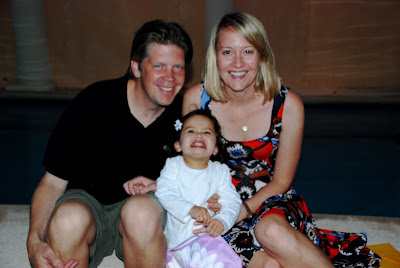
We’ve been in Merida for a little more than a month, and so far, we really have been enjoying our time here. One of the questions we get a lot is “what exactly do you do in Merida?” So while some days are more mundane than other, we’ve decide to clue you in on what the four of us (John, Nicolle, CeCe and Fidel) do, on an hourly basis in a typical day.

6 AM: The birds in the courtyard start chirping; the air is warm as the sun comes up. John’s alarm goes off and he is up making coffee: whole bean Mexican Organic, purchased at Costco in Merida. From there he migrates to the tiny office John and Nicolle share, powers up his computer, and starts his day.

8 AM: More birds are singing and CeCe stirs; John gets her up and they both make the barefoot trek across the courtyard to wake Mommy. (You all know by now that Mommy likes her sleep ...)

8:30 AM: CeCe’s breakfast is prepared and our wonderful nanny Margarita arrives. Margarita and CeCe eat a scrumptious breakfast while John continues, and Nicolle starts, the work day.

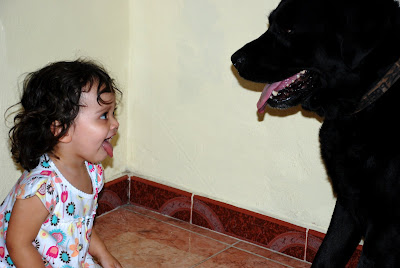
9 AM: John takes Fidel on his morning walk. Curiously, Fidel has morphed from overwhelmingly Beta dog in the United States (very passive) to complete Alpha dog (growly and kind of aggressive) since arriving in Mexico. When he's not chasing a street dog away, or peeing on someone's front door, he'll latch on to an appetizing scent which leads to a chicken bone or bit of edible garbage on the street. He's thrilled.

During Fidel’s morning walk, Nicolle tries to do her morning calls to family/friends. (In a shared office of about 100 square feet, its important to be as polite as possible.)

9:45 AM: Someone on a bicycle, scooter, or horse carriage comes past our house selling something: “carbon!” means charcoal, a ringing bell means bread, a long whistle means eggs, then there are also sounds for brooms, topsoil, tamales -- countless items, really. We always check to see what is passing by because you never know what it could be, and, you actually might need it!

By this time, Fidel has drank an entire bowl of water and has just stopped panting from his walk. He's thinking about settling into a prolonged nap on the cool tile floors.

10 AM: CeCe is dressed and sun screened and off to either Parque Centenario or the adjacent Merida Zoo with Margarita. Parque Centenario is a big wooded park with lots of fun playground equipment that you just don’t see in the parks in the US anymore. Metal seesaws, anyone? The park also has a train that you can ride for 1 peso. (A little less than a nickel.) And the Merida zoo has monkeys, giraffes, hippopotamuses and ducks ... pretty much everything. Do you know how to say hippopotamus in Spanish? CeCe does!

Noon: Nicolle and John break for lunch, right as CeCe and Margarita are returning home. We have very few barriers to getting our work done here as compared to home, simply because it is a much simpler life -- no commute, no meetings, very few weekly errands, no laundry or cleaning. So we indulge ourselves with a 90-minutes of walking and lunching, exploring the city and eating together every day. This is also a good opportunity to check out all the various houses for sale and run any errands.

Fidel? By noon he’s sound asleep on the cool tile floors, typically right in the stream of the cold air from one of the air conditioners.

12:30 PM: John and Nicolle are pounding the hot pavement of Merida, seeing what they can see, or doing an errand on the way to lunch. To give you some examples of what we do during lunch, one day we had to find a notary service. Another day, we went to look at a house that was on the market (always fun to peek behind the grand, austere exteriors of Merida’s colonial houses to see what style and/or whimsy lies within). Yet another day, we went to the market to pick up some fresh vegetables for the week. Lunchtime is always our favorite time of the day, and not just because of the delicious Mexican or Yucatecan food we enjoy ... no matter how mundane our lunchtime errand is, it’s always an adventure!

At home, Ce and Margarita have just finished a cooling bath, and are sitting down to eat something for lunch. Most of the time, it’s leftovers from the night before.

1:30: John and Nicolle run back to the office (we are always in a hurry as things seem to take a bit longer here than they would in the States) and Margarita leaves. CeCe is typically just down for her nap.

Fidel? Still sleeping, dreaming of his evening walk and the chance that he will find more chicken bones on the street ... or perhaps even a half-eaten tamale.

1:30 to 4 PM: More work for John and Nicolle. More vendors pass by our windows, which are always open. Sometimes if we are on business calls we have to explain the loud bicycle horn, the odd honking noise, or the annoying whistle as it passes by our house.

4 PM: CeCe awakes from her nap, ready to do some swimming. John is typically her swimming buddy. By now, it is at least 90 degrees outside and John is ready for a dip. And like most kids, CeCe is always ready for a dip! After about 15 minutes in the pool, John is back at his desk and CeCe is dry, eating an afternoon snack and playing with Mommy. Nicolle’s work day is finished when Ce wakes up from her nap.

5:30 PM: The family sets out for a walk in Merida, Ce in the stroller. Sometimes we go to the Main Plaza, where young couples walk, hands entwined, pigeons stroll in flocks waiting for handouts, and multitudes of hammock vendors try to sell their wares. Sometimes we go to our local park, Santiago, to see friends with a toddler who also live in the neighborhood. And sometimes we just walk.

6:45: We return home. Fidel leaves for his second long walk of the day. Typically it is on this walk that he almost gets run over by a local bus -- even with his leash on. (Fidel wouldn’t last more than five minutes in this city without a leash!)

7 PM: We eat dinner as a family. We’ve found that recently, if we go out to dinner, CeCe finds herself much too immersed in the goings-ons of other tables to concentrate on eating her own food.

8 PM: Bedtime for CeCe, and either blog time, more work, reading books, or chilling in the courtyard with a couple of cervezas for John and Nicolle.

11 PM: Bedtime for Nic+John.

Our day-to-day life here in Merida is nothing spectacular. In fact, Monday through Friday it is downright routine. However, even our routine days brings sights, sounds (and yes, smells) that we’ve never experienced before in our lives. It can be as unbelievable as a man riding down the road on a motorcycle with a 3-foot-by-4-foot piece of plywood balancing on his head holding up a pyramid of bread. Or it can be as dangerous as a man on a motorbike riding with his toddler in front of him and wife in back of him, all three sans helmets. Or as silly as the scooter selling cold milk that “moos” when the horn is activated. Or as annoying as the multitudes of dogs on roofs that look down at you and bark like mad as you pass. Or as resounding as the chirping of thousands of ka’u birds in the trees in the Plaza Mayor at dusk.

The truth of the matter is that regardless of how routine our day-to-day life actually is here, just by being here it is anything but. And we love that.

Wednesday, February 25, 2009

I Love It When a Plan Comes Together


John’s sister Robin and brother-in-law Curt came to Merida this week for a visit, and we hit the road running on Saturday morning. Being from Minnesota, we figured they might want a little beach action on the mostly deserted stretch of the beach around the Progreso-Chelem area, about a 30 minute drive from Merida. We were right. It was a lovely day, which included chips, fresh salsa and guacamole on the beach, as well as a deliciously light meal of shrimp and lobster carpaccio, lobster ravioli and seafood linguine at a quaint beachside Italian restaurant. It was a relaxing afternoon, cut a bit short due to the fact that we wanted to get back to Merida to take advantage of Carnaval.

Carnaval is a huge weeklong celebration in myriad cities throughout Latin America. Most people probably think of Rio de Janeiro, Brazil, when the word “carnaval” is mentioned, but it is celebrated to a lesser degree all throughout Latin America. What you probably didn’t know is that Merida’s Carnaval celebration is the 12th largest in all the Americas. We went to an afternoon parade last year with CeCe and had a blast, so of course wanted to go to the nighttime version with Robin and Curt.

Our babysitter arrived at 7:15 p.m., and we met Robin and Curt at their place by 7:30. As the parade is so large and snakes around such a huge part of the historic center of the city, driving (and parking) weren’t really options so we decided to walk to the restaurant I wanted to try. The only problem? The restaurant happened to be located on the other side of the parade barricades from where we were.

We started walking, and soon were turned back by policia and parade route barricades. So we walked in the opposite direction. And again we were turned back. We shuttled back and forth down side streets in flip flops, only to be turned back time and time again. We discussed the street-crossing issue with the police manning every barricade, and they all came up with the same problem-solving measure: why not just find a restaurant on this side of the barrier?

Oh no, that would have been too easy. Plus, we (I) really wanted to try this restaurant, which had come highly recommended by friends.

So on we walked until one of the side streets streets finally had a thoroughfare, available for crossing up until the floats came into view. In all fairness, we only walked about 40 minutes total. But in flips flops it felt like an eternity.

On the parade route, masses were crowding up against the barricades on the street, the crowd was growing and momentum gaining. Glitter rained down from second story colonial balconies. Thousands of people, men, women, teenagers, toddlers and babies waited. The air was electric and the mood happy. We pushed ourselves through the open gate with streams of others, crossed the street, and made it to the correct side. The restaurant was literally within eyesight ... about 25 yards away. We dejectedly realized, though, that we couldn’t walk down the road, nor could we get into the restaurant from the street. The streets were ALL barricaded by temporary fences, so people didn’t spill into the route of the parade from the sidewalks. The sidewalks themselves were stacked with chairs, table and bleachers as well. Short of a miracle, there was no way we were getting to the restaurant.

As we were about to settle on option number two, we were approached (in a crowd of thousands) by a European man who tapped me on the shoulder and said, “ I am the owner of Piedras de Agua and have one table for four left on the parade route. Do you want it?”

I was flabbergasted. It was the very same restaurant we had been trying to reach for the past hour. I quickly said yes and he simply unlocked the barricade, walked us down the 25 yards, unlocked the barricade in front of his restaurant, and promptly sat us in one of the best tables in the house -- literally inches away form the parade floats, dancers and general mayhem.

We watched from our ringside table as 90-plus minutes of cray-papered, bedazzled floats wheeled past, music thumped from speakers and Corona girls (and boys!) shook their money makers. There was a Star Wars float, a parade of Elvis’s in big lapeled leisure suits, bell bottoms, sequins and sideburns, and a dance line of older ladies (in their 70s and 80s) in bikinis tops and hot pants. Plus so much more. It was one of the finest parades I’ve ever witnessed, and one of the best spent 90 minutes of my lifetime.

Afterwards, we were whisked into a quiet courtyard to enjoy a late, delicious (and very inexpensive) dinner, complete with stars in the sky above us, Merida’s beautifully lit cathedral peeking over the manicured shrubbery, and glitter from the parade still in our hair and on our shoulders.

One of the best things about Mexico is just how some things work out, completely unplanned, perfectly. As some newly acquainted friends of ours here say, “there is magic here, you just have to let it happen.”


Wednesday, February 18, 2009

Winna Winna Chicken Dinna


During our numerous trips to Mexico, John and I have always been able to find a bit of delicious solace in something quite simple: grilled chicken.

We discovered its delicacy 13 or so years ago, when we were coming up through Mexico after a year on the road in Latin America. There’d always be a simple grill set up by the bus stations, selling grilled chicken, cut up, in bags with tortillas, hot sauce and limes -- a very cheap and deliciously satisfying meal. Since we’ve been living here in Merida, we’ve found the exact same chicken meals throughout the city as well. Always cheap. Always delicious.

Let me further explain “delicious.” The chicken meat is tender, smoky, and moist, and the skin has just the perfect amount of char. The flavor permeates every bit of the meat, seeping from the surface all the way down to the bone. And the flavor itself is something we’ve always pondered, as it is unique to the country of Mexico and to every grilled chicken we’ve ever had here. We’ve wondered for years where the mild yet defining flavor comes from: “Is it a marinade? A rub? A blend of spices thrown on after grilling? What is the secret recipe and how can we replicate it at home? Maybe it has something to do with how chickens are raised here. Or maybe the spices used are only available in Mexico?”

Seriously, people, the flavor is THAT complex.

But I’m very happy to report that since arriving in Merida, we’ve finally cracked our 13-year question. Here was our process. First, we bought a barbecue grill and bag of charcoal -- or “carbon” as it is known here. (The grill cost $7 at the market, and is made from half of a small metal barrel and welded simply and somewhat unevenly to four crude metal legs made of re-bar).

Then, we readied our grill. John piled a bunch of carbon in the grill basin and, after copious amounts of matches and fanning (carbon is more difficult to start than our charcoal), eventually he was rewarded with a smoldering pile of coals.

Then we simply salted, peppered and lime spritzed our bone-in chicken breasts (that we got at Costco, a slice of heaven right here in Merida, by the way) and in about 25 minutes, we had our own version of the ever-delicious grilled Mexican chicken. We created the very same delicious flavor that we’ve always wondered about.

The answer, like the grilled chicken itself, is alarmingly simple: It’s the charcoal!

So the BIG question is: what is the difference between carbon (in Mexico) and the charcoal briquettes we use? Here’s what we found online, which is kind of interesting.

The mesquite tree is harvested for carbon (charcoal) in Mexico. Mexican carbon is made by putting mesquite into a pit, lighting it on fire, and then covering it in soil or earth. The wood continues to burn and turns into carbon -- literally, lumps of burned wood.

American charcoal briquettes are made by compressing sawdust and other wood by-products, with a binder, usually starch, as well as other additives. Briquettes may also include brown coal (a heat source), mineral carbon (a heat source), borax, sodium nitrate (an ignition aid), limestone (an ash-whitening agent), raw sawdust (an ignition aid), and other additives like paraffin and petroleum solvents to aid in ignition as well.

Tuesday, February 10, 2009

The lo-o-o-ng drive down


Hola everyone. We have now just gotten settled here in Merida, after a (very) long road trip down. We figured that we went nearly 2,000 miles in Mexico, down through Texas, to Monterrey, then on to San Luis Potosi, to San Miguel de Allende, to Puebla, to Campeche, and finally to Merida. As many of you know, we drove down with our Black Labrador Fidel and two-year-old daughter Carolina. Before setting out, we had been pretty excited at the thought of a prolonged road trip through Mexico, but by the time we got to Merida, we were really happy to be out of the car. We've come up with a few highlights, low lights, and general observations about a road trip in Mexico, in case any of you ever find yourself behind the wheel of a car for an extended driving trip south of the border.

Cops in Mexico

They are not all as crooked as you might think. But they certainly are not all boy scouts, either. Our batting average was even Steven: 50-50. We were pulled over twice during our road trip -- both within the first 24 hours on the road, right before we got to Monterrey, and as we were trying to leave Monterrey about 17 hours later. (It was a difficult first day, to say the least.)

The first officer said we were speeding; technically, he was right. (We were speeding, but we weren't going as fast as the other cars on the road.) The difference was that our car had a bike and a Yakima box on top, and MN plates. He knew we were easy money. He went through all the motions ... checked the passports, checked our driver's permit, made some small talk about the drive ... and then hit us with the speeding charge. We told him "we'd be happy to pay our fine now rather than wait for a court date," which is the acceptable way of initiating a bribe. He started the bidding at 1,200 pesos -- about $85. We countered at 200 pesos -- about $13. He looked at his partner, they nodded, grabbed our 200-peso note, ran off to the squad car and peeled out.

The next day in Monterrey, we had a bear of a time getting out of the city. Our hotel was in the middle of the city, and at nearly 4 million people, the city is very difficult to navigate. Of course we got lost following the signs out of the city (I think we followed them too literally ... more on that later), and took an (illegal) left turn to try and get turned in the right direction. The next thing we knew, there were sirens sounding and light flashing behind us. We couldn't believe it.

Officer #2 came up to our window and asked for all the same info: passports, driver permit info, but skipped the small talk. All he wanted to discuss was our illegal left turn, and seemed genuinely concerned for our safety, explaining that there are so many accidents in Monterrey, most of them caused by people from other cities (or countries). He then explained to us exactly what we had done wrong, even using a paper and pencil to diagram the nuances of Mexican stoplights. He then suggested we be very careful, as the majority of Mexican policemen are crooked and will, at best, ask for a bribe and, at worst, haul you in. He then asked if we wanted to return to the scene of the crime and watch a few rounds of the stoplight, just to make sure we understood traffic lights. We nodded and agreed up till his final request ... we just couldn’t go back to the scene of our crime if we wanted to make it to our destination, San Luis Potosi, before dark. We pointed to CeCe in her car seat and explained our circumstances.  It was, after all, nap time for CeCe, and we had miles to get under our belts.

He agreed; he hadn’t realized we were traveling with an infant. He then did the unfathomable: he offered us a police escort out of town. He told us to follow his flashing lights; he'd bring us to the freeway entrance. We were psyched. A police escort. We’d FOR SURE get to the correct highway.  And we did, quickly and without incident. Before we got on the highway, we pulled over and he came up to our car to wish us the best, and to warn us to be careful on the roads. He shook both of our hands, we thanked him profusely, and we were off. No bribe, not even a payment for our police escort out of town ... just one of the best guys in uniform we'd ever met.

Traffic and Roads

When driving in Mexico, you typically have a few options as far as roads are concerned. First, there are the local roads that go town to town, connecting all of the tiny dots of Mexican towns to one another. Mostly these roads are paved and in “fine” condition, but they comprise an insane amount of speed bumps. We quickly learned that speed bumps are the ONLY way to get Mexican drivers to slow down -- otherwise they go as fast as they possibly can. (In the case of a 1960 VW Beetle, that's 50 mph. In the case of a 2009 Porsche, that's 150 mph.) So, if you don't want to stop on average once every 200 meters, you have to pay to drive the swanky toll roads that link all of Mexico's larger cities.

On our trip, we did the majority of our driving on toll roads. They are great quality roads, and most of them are divided highways. What we didn't realize is how much we would spend on them. For example, the toll road to Cancun from Merida costs $320 pesos, or about $23 for a 200-mile road. Another toll road outside of Ciudad de Carmen on the coast costs about $15 for about 30 miles, but it allowed passage over two enormously long bridges over an ocean inlet -- one was five kilometers long, the other was four. The only nice thing about the steep price is that it keeps the majority of local, slow-moving traffic (say, a horse-drawn carriage or a 1940s beater whose top speed is 35 mph) off the road.

The majority of people who take the toll roads are cross-country truckers and Mexicans with money. Both of these groups of people, we realized quickly, like to drive fast. Really fast. And pass on blind, uphill curves. And ride your bumper within inches, literally inches. But the scariest thing for us were the semi trucks. You see, the majority of trucks in Mexico are double and triple semis. You always end up getting stuck behind them as they can't go very fast up the mountainous roads. But it’s when they get up to normal highway speeds that they are the most dangerous.  At any speed over 45 mph, their multiple trailers sway back and forth in opposite directions -- taking up almost both lanes of the two-lane divided highways. Having to drive behind them for any amount of time makes you get religion quick. I probably wondered a thousand times during our road trip what would happen if one of the trailers were to break free and come careening towards us. It's pretty obvious what would've happened; I just kept hoping that John would be able to miss it, somehow.

Traveling with a toddler

A couple of insights here when you go on a really long trip:

1. Get the built-in DVD player. As maddening as listening to Dora songs are, your alternative is a screaming baby for hours. All of a sudden, "Turn the Wheel, Isa" isn't such an annoying song.

2. Junk food, especially when eaten instead of lunch, can actually appease a toddler.

3. Drive over nap times. Like, duh.

4. Threats work, and they don't even have to be legit.  For instance, you can say "If you don't stop crying, you will not be able to go swimming when we get to the hotel" even if a) you don't know where you will be staying, and b) if that nameless, faceless hotel even HAS a pool.

5. Don’t underestimate the power of “yes.” As in “yes” you can have that cookie; “yes” you can listen to your CD; “yes” I’ll read you a book; and “yes” I’ll do just about anything to avoid a screaming baby.

Signage in Mexico

1. The signage in Mexico is fairly nonexistent. Especially, say, if you are in the middle of a city of four million, with hundreds of cars honking and roaring past you, and the street you are on suddenly breaks into six offshoots in different directions. In that case, my friend, you are completely on your own. None of those offshoots will have signage. And god help you if you are on that road in the dark. Better just to pull over on the shoulder and sleep there for the night.

2. If a sign in the aforementioned huge city (or any city for that matter) says to go "straight" you might actually need to navigate multiple turns, some hard turns, as part of that "straight" route.

3. Many times, distance signs are wrong. For example, you'll see a kilometer distance sign, and drive for 15, 20, even 30 minutes. You’ll come up upon another kilometer distance marker, but strangely, it says there are MORE kilometers to your destination than the previous sign. By the way, this phenomenon might bring you to tears after a 7-hour day in the car.

4. Painted lane markers mean nothing. Two theories behind their existence: they are merely a way to use up extra paint in Mexico, or to provide jobs to people who need work. And if you were wondering, painted shoulder lines don't mean anything either.

5. Signs tend to fade out in Mexico ... and they never are replaced. Especially the signs that fade out at the juncture of three major highways in the middle of a very busy city.

6. If there is a "No Bicycle" sign on the highway you will see a bicycle once every couple of minutes.

Our conclusion after doing this road trip?

Fly. Do not take a 2,000-mile road trip in Mexico with a two-year-old and a dog.

Thursday, February 28, 2008

Happy Adoption Day, CeCe!


On February 27, we celebrated Carolina’s adoption into our family.

One year ago, we met our little Carolina in a high-rise luxury apartment in Bogota; she was bundled all up in blue. She didn’t cry when Rosita, the director of Los Pisingos, put her in our arms – but John and I sure did. She just kind of took both of us in and seemed to decide immediately, “Well, I guess these are my two new parents.” She promptly fell asleep in John’s arms in the cab ride home.

A year after that life changing day, it was a normal day in Merida for us. John and I worked at our desk (we share a desk here), but we also did a couple of Carolina’s favorite things during the day: we took a dip in the pool before naptime, and we took a walk to the park at dusk and watched as people fed big flocks of pigeons … every time they took flight we’d get a half amused-half scared “wooooooo!” out of Carolina.

And to top of our one year anniversary as a family? Carolina’s favorite dinner, of course – pizza! As dessert, we got a small orange pastry cake that we shared as a family. Unlike at her first birthday party, Carolina dove right into the cake, and slowly but surely finished her piece. She loved it, and enjoyed her sugar high afterwards as well.

What we’ve decided this past year with Carolina: you can have your cake and eat it, too!

Wednesday, February 27, 2008

Behind Bars


John left last week to go to Texas for business, so CeCe and I had a couple of girl’s days, enjoying each other’s company as we explored the city, swam in our pool, and danced to music on the iPod.

And of course there was some excitement, too – mind you, the sort of excitement that would have never happened when John was working with me all day, every day in our little casa. It had to happen one of the three days he left town.

CeCe and I were waiting for the water guy to show up and deliver our big 20-liter jug of purified water. It was 2:00 and he was supposed to have come at 1:30. We were anxious for him to arrive because it was getting close to nap time, and we wanted to take a swim before going to bed. (It was hot, and CeCe loves the pool!) So after waiting, and waiting, I decided to take one last peek out my front door before getting into the pool.

Our doorway, by the way, is two-fold. There is a big heavy wooden door with a secure lock leading into our house. This door opens in the middle, but one side is always bolted shut with prongs that extend down into the cement floor, and up into the cement archway. Then there is a space of about 18 inches and an outer wrought iron gate that also latches in the middle and goes the full way, floor to top the arched entry way, of our door. Even though Merida is known for being the safest city in Mexico, we bought a padlock to put on the outer wrought iron door, just in case.

When I went out to see if the water guy was cycling his way down my street, the padlock was on the wrought iron gate. And as I peered out the gate to look, I heard an immediately disheartening “click” behind me. CeCe loves to close doors, and with that one little push she had managed to simultaneously lock me in AND lock me out. I was trapped between locked doors – without, you guessed it –keys.

I panicked. My thought process was something like: “John is in Texas. My nanny is gone for the day. I don’t know the phone number or last name of our landlord. I don’t have my keys. It’s so hot out here!” But most disturbing of all, by far? “CeCe is home alone, inside the house! What trouble can she get into?!?”

I tried to bang against the door to the house with my back and legs … to no avail. I couldn’t get a run at it because the space I was in was a mere 18 inches or so. Plus, all it did was make CeCe, who was sitting in the corner by the door, cry harder. So I took my case to the streets.

I flagged down an old guy on a bicycle as he slowly wheeled by, and was pretty blunt with him in Spanish. “I need help right now,” I said. “My baby locked me in here and she is alone in the house.” He looked at me like I was crazy, but agreed to help. He said he knew a locksmith who lived “right down the street” and would go and get him. Imagine that – it was almost too good to believe. But after about 10 minutes of waiting for him I thought it most certainly was too good to believe, so I flagged down another guy driving by in a car. He promised to call the cops.

As it turns out, I should have kept the faith in my friend on the bicycle, who returned with the locksmith as promised. The locksmith tried the outer padlock for about 10 minutes, as I talked to CeCe through window in the door. (Also covered in wrought iron, by the way, or I surely would have punched through that.) She could hear me and whimpered a bit occasionally, but didn’t move from her corner right by the door. He couldn’t pick the padlock (which, after I was freed, actually made me feel kind of good) and squeezed his arms through the iron gate to work on the door itself. He got that one in about 5 minutes. Thank God!

I scooped CeCe up – she was still in the corner. She was clutching one of John’s flip flops and was blotchy and red in the face from crying so much.

I thanked the men profusely, paid the locksmith his fee of 100 pesos (about $10) and gave my friend on the bicycle a tip of 50 pesos for delivering the godsend of a locksmith. The cops showed up about 10 minutes after I had been freed from my prison cell – two squad cars, lights a’flashing, four cops, no less. Immediately after we got back into our house, CeCe and I took that long awaited, much deserved swim.

And the water guy? He wheeled up at about 5 pm that day … about 3 ½ hours later than I had expected.